
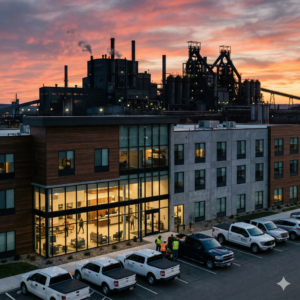

The Industrial Amenity: Infrastructure-Led Workforce Lodging


Discover how hospitality is becoming an industrial amenity. We explore the $1.3M Ohio hotel case study and why corporate “basecamps” are the new recession-proof CRE play.
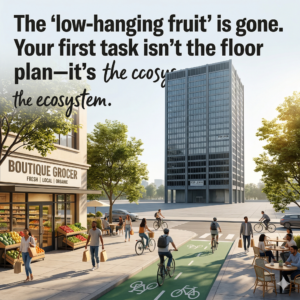
The New Alpha: Urban Curation in Office Conversions
The focus of CRE has shifted from building ‘bones’ to neighborhood context. Learn why the 15-minute city model, cultural gravity, and walkable infrastructure are now essential for risk mitigation and financial viability in office-to-residential conversions.

The 2026 Maturity Wall: Commercial Real Estate’s Surgical Reality Check

Prepare for the market reset. Analyze the $875 billion debt cliff facing hospitality and industrial sectors, and learn how private credit can bridge the valuation gap.
The Federal Workforce Crisis is a Commercial Real Estate Crisis

For decades, holding a General Services Administration lease in your portfolio was the ultimate gold standard in commercial real estate—a recession-proof asset backed by the U.S. Government that offered bond-like stability. But as of March 2026, those assumptions are officially obsolete.
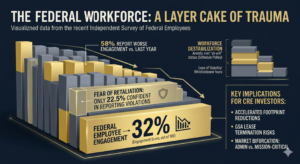
We are currently witnessing a total collapse in civil service morale, with federal employee engagement plummeting to an unprecedented 32 out of 100. Driven by political anxiety, massive turnover, and a loss of whistleblower protections, this disengaged workforce is simply no longer showing up to the physical office. This has created a massive spike in ‘shadow vacancy’. The government is no longer paying for empty desks ‘just in case’—in fact, under new 2026 rules, properties failing to maintain a 60% utilization rate are being actively marked for consolidation or sale.
The era of ‘set it and forget it’ federal investing is officially over. Moving forward, the only true ‘safe havens’ are mission-critical properties that cannot operate remotely, such as high-security SCIFs, government labs, and VA hospitals. The bottom line for investors is stark: if the people aren’t showing up, the lease eventually won’t either